
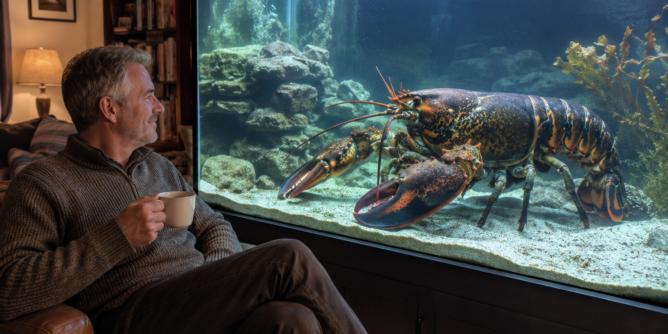
Yes, Doc — a cold-plunge chiller can absolutely be run day-in/day-out on a lobster tank, provided it’s sized so the compressor cycles rather than running flat-out continuously.
Some cold-plunge systems are explicitly intended to stay powered and circulating 24/7; Plunge’s own guidance, for example, says its system should run 24/7. (Plunge Support)
The catch is this: a chiller being on 24/7 is fine. A compressor being on 100% of the time because it can barely keep up is not what I’d want for a permanent lobster system.
For your setup, I’d aim for:
Tank → mechanical/bio filtration → circulation pump → chiller/heat exchanger → tank
and size the chiller so, once the tank reaches setpoint, it might run something like:
10–30 minutes ON → 10–30+ minutes OFF, depending on room temperature, insulation, pumps, lighting, etc.
For your 150-gallon system
If you’re still talking about holding it around 65–68°F, that’s actually a pretty easy job for a decent cold-plunge chiller compared with its normal assignment of dragging a plunge tub down into the 40s. Many plunge chillers are designed to reach temperatures around 37–40°F. (The Spruce)
So a ½ HP or 1 HP plunge chiller on 150 gallons at 65–68°F could potentially have a very comfortable duty cycle, depending on the ambient temperature.
And here’s an important distinction from our CW-5200 discussion yesterday:
I’d actually prefer a purpose-built cold-plunge chiller over the CW-5200.
Why?
A plunge chiller is already designed to:
- circulate water
- tolerate substantial water volume
- run unattended for long periods
- operate at relatively low water temperatures
- cycle from a thermostat
- reject a meaningful amount of heat
- run repeatedly every day
The CW-5200 is fundamentally an industrial process chiller, usually meant to cool equipment such as laser tubes/spindles—not a 150-gallon biological system. A plunge chiller’s application is much closer to what you’re doing.
One giant lobster-tank caveat
I would not automatically run saltwater directly through the plunge chiller unless the manufacturer explicitly says its wetted components are saltwater-safe.
That’s where I would retain the idea we discussed:
Lobster saltwater loop → titanium heat exchanger ← freshwater chiller loop
That gives you the best of both worlds.
The plunge chiller lives happily circulating clean freshwater, while the lobster tank’s seawater only sees PVC/plastic + titanium.
That is a much better permanent installation than gambling on whatever copper, brass, stainless steel, brazed plate exchanger, pump shaft, or fittings happen to be hiding inside a generic plunge chiller.
And since you’re keeping lobsters rather than humans, corrosion isn’t the only issue — dissolved copper contamination would be particularly undesirable for a marine invertebrate system.
One other wrinkle: commercial American-lobster holding systems often run considerably colder than your 65–68°F target. Long-term holding recommendations commonly get down into roughly 40–48°F, because the low temperature depresses metabolism. (The University of Maine)
But if your goal is a display/live-animal system rather than commercial food holding, that’s a different husbandry question.
For your 150 gallons at ~68°F, Jay-bird, I’m increasingly convinced that a ½–1 HP cold-plunge chiller + separate freshwater loop + titanium exchanger is probably the cleanest DIY solution we’ve talked about yet.
